






From Capital Gains to Cash Flow
-
3 Min Read
-
Business
-
Aug 2026
From Capital Gains to Cash Flow
-
3 Min Read
-
Business
-
Aug 2026
Outlook Magazine | August 2026 | Pg 162 – 163
TOP STOREY Kausar Firdausi
India’s maturing real estate market is shifting from speculative profits to steady income, redefining how developers build, investors invest and assets are valued.
The rules of real estate investing are being rewritten. For years, success was measured by how much a property’s value appreciated. Today, investors are increasingly asking a different question: How much income can the asset generate while it is owned? As India’s real estate market matures, growing institutional participation, the rise of REITs and evolving buyer expectations are shifting the focus from speculative gains to recurring rental income and operational performance.
According to Prasun Kumar, CMO, Magicbricks, the traditional ‘buy, inflate and sell’ model is giving way to an income-driven approach where net operating income (NOI), rather than exit multiples, increasingly determines success. Institutional investors are now evaluating assets on cash-flow stability, tenant quality and lease structures instead of relying solely on capital appreciation.
This shift is compelling developers to rethink their business models. Shekhar Patel, MD, Ganesh Housing Limited, believes that the industry is moving from a transactional mindset to an ownership mindset, where long-term value is created through thoughtful planning, sustainable design, strong tenant ecosystems and professional asset management. “The next phase of growth will belong to developments that create enduring economic value for businesses, investors and communities,” he adds.
Rental income has consequently become a critical investment parameter. Mahesh Agarwal, MD, Purti Realty, is of the view that while prime residential markets continue to appreciate, investors are increasingly evaluating assets based on rental yields, occupancy levels and asset quality. In Mumbai’s premium micro- markets, Ram Raheja, MD, S Raheja, says that buyers are now asking not only what a home will eventually sell for, but also what it can consistently deliver throughout ownership.
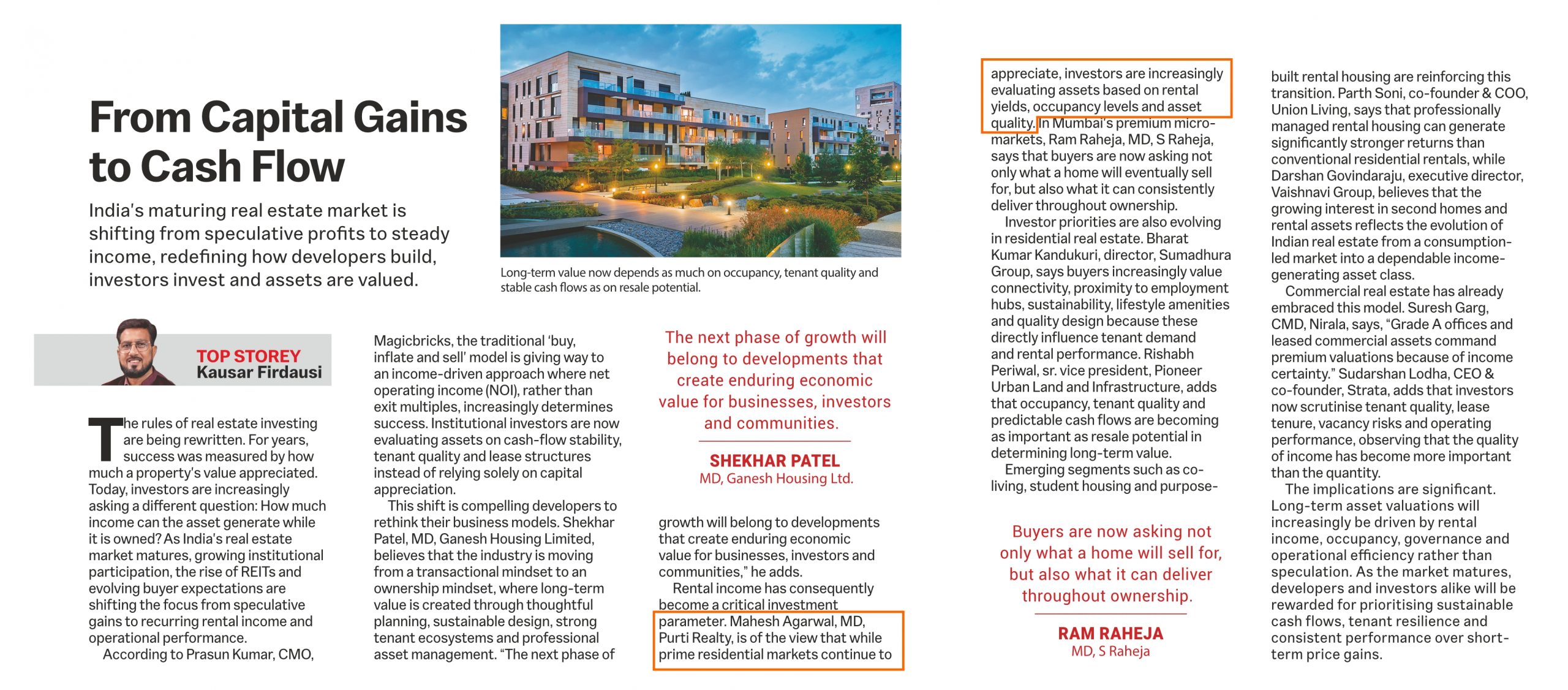
Investor priorities are also evolving in residential real estate. Bharat Kumar Kandukuri, director, Sumadhura Group, says buyers increasingly value connectivity, proximity to employment hubs, sustainability, lifestyle amenities and quality design because these directly influence tenant demand and rental performance. Rishabh Periwal, sr. vice president, Pioneer Urban Land and Infrastructure, adds that occupancy, tenant quality and predictable cash flows are becoming as important as resale potential in determining long-term value. Emerging segments such as co- living, student housing and purpose- built rental housing are reinforcing this transition. Parth Soni, co-founder & COO, Union Living, says that professionally managed rental housing can generate significantly stronger returns than conventional residential rentals, while Darshan Govindaraju, executive director, Vaishnavi Group, believes that the growing interest in second homes and rental assets reflects the evolution of Indian real estate from a consumption- led market into a dependable income- generating asset class.
Commercial real estate has already embraced this model. Suresh Garg, CMD, Nirala, says, “Grade A offices and leased commercial assets command premium valuations because of income certainty.” Sudarshan Lodha, CEO & co-founder, Strata, adds that investors now scrutinise tenant quality, lease tenure, vacancy risks and operating performance, observing that the quality of income has become more important than the quantity.
The implications are significant. Long-term asset valuations will increasingly be driven by rental income, occupancy, governance and
operational efficiency rather than speculation. As the market matures, developers and investors alike will be rewarded for prioritising sustainable cash flows, tenant resilience and consistent performance over short- term price gains.
