






Connectivity and premium demand drive Kolkata’s next realty cycle
-
5 Min Read
-
Business
-
Sep 2026
Connectivity and premium demand drive Kolkata’s next realty cycle
-
5 Min Read
-
Business
-
Sep 2026
Article Link: https://etedge-insights.com/resources/in-conversation/connectivity-and-premium-demand-drive-kolkatas-next-realty-cycle/?amp=1
ET Edge Insights
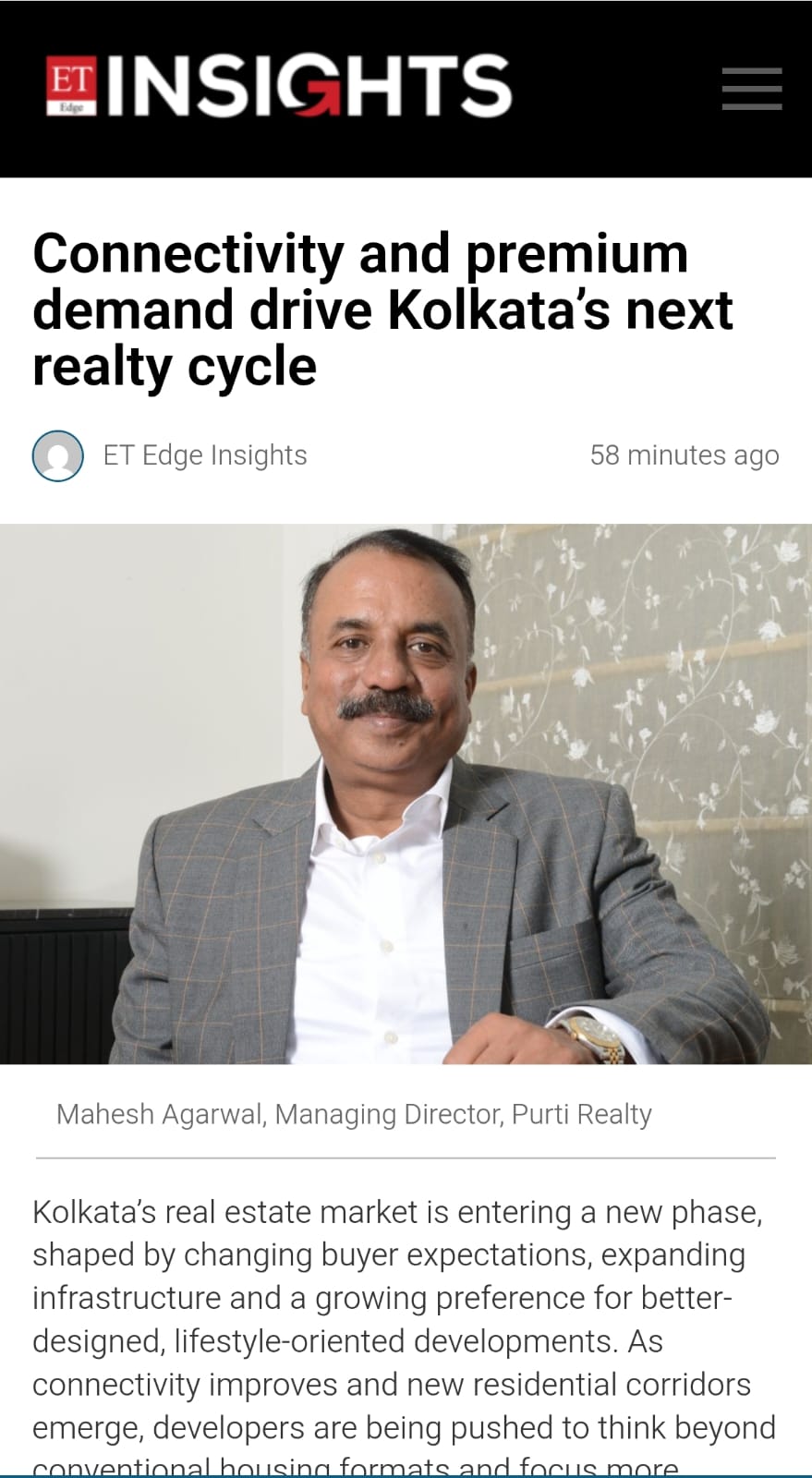
Kolkata’s real estate market is entering a new phase, shaped by changing buyer expectations, expanding infrastructure and a growing preference for better-designed, lifestyle-oriented developments. As connectivity improves and new residential corridors emerge, developers are being pushed to think beyond conventional housing formats and focus more closely on long-term value, liveability and sustainability. Mahesh Agarwal, Managing Director, Purti Realty, shares his perspective on the forces likely to shape the next phase of real estate growth in Kolkata and Eastern India.
India’s housing market is witnessing a clear shift towards premiumisation. How is this playing out in Kolkata and Eastern India?
The shift is becoming increasingly visible. Buyers are no longer evaluating a home purely on the basis of price, size or location. Factors such as design quality, open spaces, wellness, privacy, community infrastructure and connectivity are playing a much larger role in purchase decisions.
Affordability, of course, continues to matter. What has changed is the definition of value. Buyers are more willing to pay a premium when they see a clear improvement in the overall living experience and believe that the property will retain long-term relevance.
We are also seeing growing interest in lower-density housing formats, including villas and second homes. This reflects a broader lifestyle shift among buyers looking for more space, privacy, and access to nature without becoming disconnected from the city.
For developers, this means the focus has to move beyond simply delivering residential units. The larger opportunity lies in creating well-planned living environments that respond to how people want to live over the next decade.
How important will infrastructure be in determining Kolkata’s next real estate growth corridors?
Infrastructure will continue to be one of the most important catalysts for real estate growth.
The expansion of Kolkata’s Metro network, improvements to road connectivity and new transport corridors have the potential to change the way both residential and commercial development is distributed across the city.
Areas that were once considered peripheral can become significantly more attractive when commute times reduce and access to employment centres improves. Better connectivity can also create opportunities for mixed-use developments, new residential clusters and lifestyle destinations beyond traditional city limits.
However, infrastructure by itself is not enough. Sustainable real estate growth requires a combination of transport connectivity, employment opportunities, social infrastructure, schools, healthcare and quality urban planning.
The most successful emerging corridors will ultimately be those where these elements develop together.
Sustainability has become an important part of the real estate conversation. How is this influencing project design?
Sustainability is increasingly moving from being an additional feature to becoming a core part of project planning.
Buyers are far more conscious today about the environmental quality of the spaces they live in. This is encouraging developers to look more closely at natural light, ventilation, water management, energy efficiency, landscaping and responsible construction practices.
The emphasis should be on practical sustainability rather than simply adding a few green features to a project. Measures such as rainwater harvesting, treated-water reuse, efficient energy systems, better material choices and thoughtful site planning can make a meaningful difference over the lifecycle of a development.
Open spaces and wellness-focused environments are also becoming more relevant, particularly as buyers increasingly associate good real estate with quality of life rather than only built-up area.
The long-term objective should be to create developments that are environmentally responsible while remaining functional, efficient and commercially viable.
Where do you see the strongest opportunities for real estate growth over the next few years?
There are opportunities across multiple segments, including premium residential, villas, hospitality, integrated developments, commercial real estate and newer asset classes.
Established urban markets will remain important, but improved connectivity is also opening up opportunities in new corridors that were previously considered less accessible.
The key, however, is to avoid expansion for the sake of expansion. Real estate is a capital-intensive business, and sustainable growth requires disciplined project selection, strong execution and a clear understanding of local demand.
Developers need to assess not only where demand exists today, but also whether a location has the potential to sustain economic activity, infrastructure development and buyer interest over the long term.
Growth has to be measured not simply by the number of projects launched, but by the quality of execution and the ability to create lasting value.
What will define the next decade of real estate development in Eastern India?
Eastern India has significant headroom for growth across residential, commercial, retail, hospitality, logistics and industrial development.
As infrastructure improves and economic activity becomes more distributed, the region could see the emergence of several new development clusters beyond traditional urban centres.
The larger shift, however, will be in how real estate itself is conceived. The industry is gradually moving from a building-centric model to an ecosystem-led approach, where developments are expected to integrate living, working, leisure and community experiences.
In that environment, developers will increasingly be judged not only on sales or project delivery, but also on the quality of the spaces they create, the experience they provide to customers and the long-term relevance of their developments.
For the industry, success over the next decade will depend on balancing growth with execution discipline, sustainability and a deeper understanding of how consumer expectations are evolving.
